

Shopping Bag
Popular Suggestions



About us
ABOUT
The Department of Physical Medicine and Rehabilitation [PMR] at AIIMS Jodhpur is situated in the blue city of Rajasthan which is also the second largest city in the state. The department is working as a comprehensive rehabilitation center which provides services in neurorehabilitation, pediatric rehabilitation, musculoskeletal rehabilitation, pulmonary rehabilitation, speech and swallowing disorders. The department provides outpatient, inpatient and referral rehabilitative services for the institute. These rehabilitative services mainly focus on locomotor issues inclusive of holistic pain management to our patients who come with a myriad of diagnoses in the form of conventional as well as interventional [both ultrasonographically and fluoroscopically] nerve blocks, epidural injections, ozone nucleolysis, regenerative medicine and radiofrequency ablations. The department also runs a one year post-doctoral fellowship in Chronic Pain and Palliative Care along with the department of anesthesiology and critical care, providing training to two fellows annually.
Currently the department is manned by two consultants- Dr. Ravi Gaur (Additional Professor and Head) and Dr. Nitesh Manohar Gonnade (Associate Professor), four Senior Residents and thirteen Junior Residents. The rehabilitation teams consist of physical therapists, occupational therapists, speech and language pathologists, nursing staff and NCV/EMG technicians. We provide state of the art facilities for pulmonary rehabilitation, neurological rehabilitation including Virtual Reality programs, G-studio gait analysis and 3-D Motion Gait Analysis Lab. There are ongoing projects run under the esteemed guidance of our faculty on Osteoarthritis, post Mastectomy rehabilitation, adhesive capsulitis, low back pain, carpal tunnel syndrome, trigeminal neuralgia, post-stroke upper extremity rehabilitation, spasticity management and diaphragmatic analysis in phrenic nerve palsies. The department collaborates with departments of Neurology and Neurosurgery for peripheral postings of our academic junior residents. The department of PMR started tele-consultation services at tribal-dominated Community Health Centre (CHC) at tehsil Abu Road, district Sirohi, Rajasthan (~250 KM from Jodhpur) under Centre of Excellence (COE), AIIMS, Jodhpur (A Collaborating Centre for Indigenous health, Ministry of Tribal Affairs, GoI).
A JOURNEY THROUGH HISTORY, CULTURE, FOLKLORE AND MORE…
The indigo spilled city of Jodhpur, situated in the erstwhile princely state of Rajasthan has a story to tell in every corner. One does not have to be a history aficionado to comprehend all that this city has to offer. However, if you do delve into the depths of these tales, you will find yourself walking through the streets of a realm forlorn.
Jodhpur is the second largest city spanning 455 km2 in Rajasthan, founded by Rao Jodha in 1459. Rao Jodha was a valiant Rathore ruler of the Marwar kingdom. The seat of his throne was previously in Mandore and later shifted to Jodhpur. The site which was found strategically suitable to build the royal fort was atop a hill which was the home to a hermit. The hermit was aversive to dislocating and thus cursed the kingdom with eternal drought. A human was to be buried alive to reverse the curse. A man named Rajaram Meghwal volunteered to be buried alive and thus came about the foundation of Mehrangarh Fort, laid on human sacrifice. The family of Rajaram Meghwal was aptly compensated and till date, the first lamp is lit on the burial site as a mark of respect on the Foundation Day of the fort, annually.
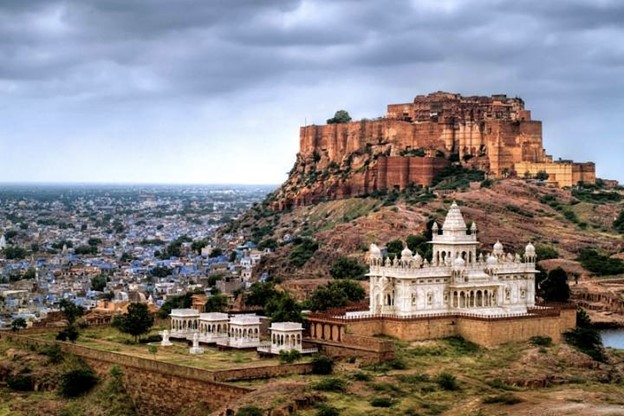
Jodhpur, like all major seats of various Rajput kingdoms, was a walled city. Parts of the old wall can still be seen in dilapidated condition around the fort and the old city. The city was guarded by eight named gates, some of which have stood the test of time and serve as gateways of residential colonies.
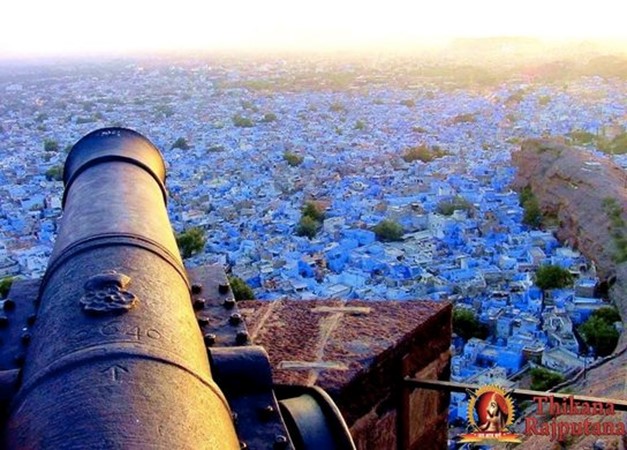
As known widely, Jodhpur is known as the ‘Blue City’ for the houses here are painted a bright indigo blue. Legends say that earlier, the houses of the Brahmin community were painted blue for easy recognition, in order to prevent attack from other Hindu kingdoms. Some theories say that the soothing blue keeps these houses cooler, for the residents to tide over the scorching heat of Rajasthani summers. Some theories further say that brilliant blue colour wards of the mosquitoes.
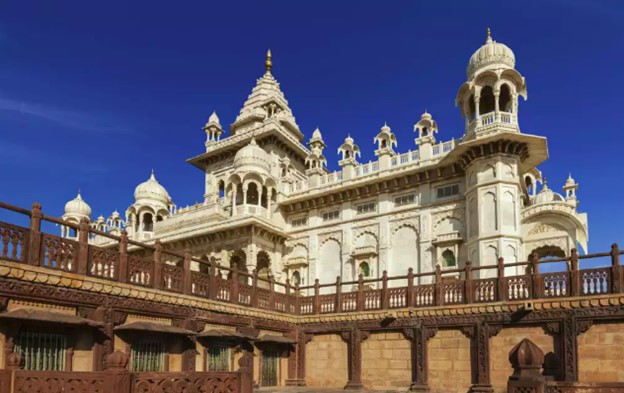
Jaswant Thada, also known as the Taj of Marwar is a mausoleum and cremation ground for the descendants of Maharaja Jaswant Singh.
The Maharaja wanted his last resting place to be where the entirety of his beloved city- Jodhpur could be seen from.
The pristine white marble of Jaswant Thada was sourced from Makrana, the same place where the stone for Taj Mahal was brought from.
A museum in Jaswant Thada displaying portraits of Marwar rulers along with informative didactics – the information serves as orientation space to understand the history of Marwar through the Portraits. Its grounds serve as a serene venue for morning concerts during music festivals such as the Rajasthan International Folk Festival and the World Sacred Spirit Festival.
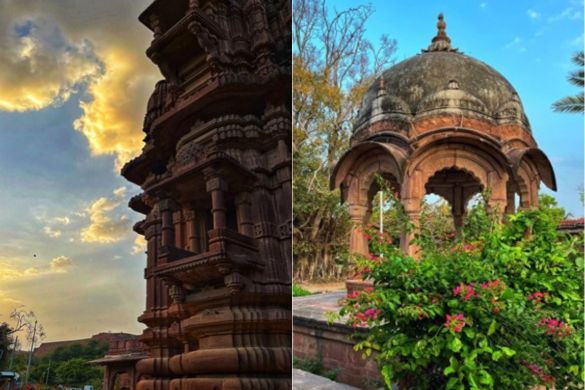
Mandore Gardens are a scenic landscape depicting the history of Marwar kingdom. Mandore was the capital city of this region before Jodhpur and hence holds important historical significance. While strolling in these gardens, one can find many ancient temple like structures, fountains and a variety of flora. If reached on time, one can catch the beautiful light and sound show which tells tales of the dynasty in a captivating manner.
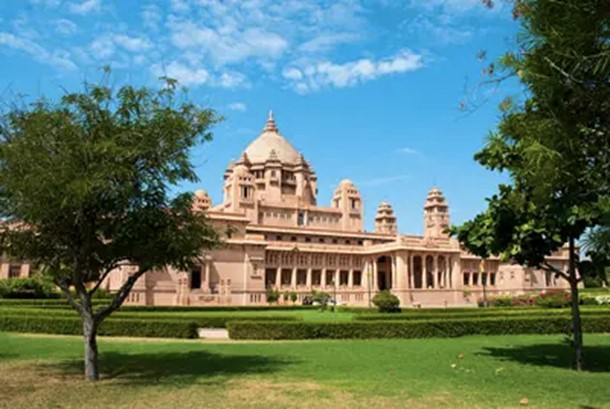
Umaid Bhavan Palace is the home to the Marwar Royal Family, a wonderful example of modern architecture with a touch of Rajputana Heritage. One of the largest and costliest heritage hotels in the world. It has also been voted as the best hotel in the world. It was built by Raja Umaid Singh to provide employment to the famine-stricken people of the kingdom. The palace houses a museum showcasing a brief history of the kingdom, a small armory and a gift shop. The luscious green lawns of the palace provide a brilliant contrast to the sandstone of the palace in the backdrop.
The blue city of Jodhpur is adapting to the modernity of the present era but it still claws to its deep rooted traditions and values. Walking down the narrow bylanes of the city, one can easily get lost in the trail of time. The city holds many mysteries like any other ancient city in the world. It is up to the visitor how deep they are willing to dive into the abyss of history.
दिल में सुकून, आंखों में आराम सा है
ये इश्क़ कुछ जोधाना की शाम सा है |
Some more places to pay a visit in and around Jodhpur:-
1.	Toorji ka Jhalra
2.	Clock Tower/Ghantaghar
3.	Sardar Bazar
4.	Gulab Sagar
5.	Pachetiya Hill
6.	Sidhnath Mandir
7.	Jagnath Mandir
8.	Masuriya Hill
9.	Sardarpura Market
10.	Rao Jodha Desert Rock Park
11.	Osian Desert Park
12.	Arna Jharna
HOW TO REACH JODHPUR
Jodhpur has good connectivity via road, flight and by train. The main airport of the city is just 5 km away from the focal point of the city. Jaipur, Delhi, Udaipur, Bangalore, Chennai, Pune, Hyderabad and Mumbai are well networked with frequent flights on a daily basis. The most important international terminal, Delhi is situated at a distance of 600 km from Jodhpur. Flights from Delhi to Jodhpur and Jaipur to Jodhpur flights are easily available. Jodhpur owns one of the major railheads in the North-Western zone of Indian railway. It possesses good connectivity with other important cities of the country including Delhi, Kolkata, Chennai, Mumbai, Bangalore, Jaipur, Jailsalmer and Mumbai. All these cities are nicely linked in such a way that one would not find any trouble to figure out how to reach Jodhpur. The state of Rajasthan runs a well oiled Road Transport Corporation that is capable of providing frequent bus services towards all the important regions in and around Rajasthan from Jodhpur. One can also hire private deluxe buses and cabs to and from Jaipur (345 km), Delhi (600 km), Jaisalmer (290 km), Bikaner (240 km) and Agra (580 km) respectively.